Archive

Tag Archives: income


My stated intent with this blog is to help my fellow Boomers navigate through the morass of issues that are facing those of us born between 1946 and 1964 as we age together.  I think I know what those major issues are; at least I know which ones keep me awake at night.  In the interest of democracy and the realization that there are most probably many, many other issues facing Boomers that I have not yet encountered I tried a little experiment:  I GOOGLED “problems facing Boomers” and,  in 1/3 of a second I received 565,000 responses.  Five Hundred and Sixty Five Thousand!  It’s no wonder I have a hard time getting the recommended amount of sleep every night.

The first thing that jumped out at me was a FOX NEWS report from last year that simply stated “If MEDICAREENROLLrates of disease and disability continue at their current levels, America will become a nation of sick, senile, disenfranchised, impoverished seniors, with too few resources to care for them and astronomical medical costs that will cripple our economy.”  Cheery thought, that, but it kind of sums up challenge.  I don’t know about you but I am not looking forward to living out my golden years as a depressed, sickly old man wearing tattered Dockers and an old flannel shirt waiting on the veranda of my government subsidized housing for one of my grandchildren to pick me up for an outing to the local park, hoping I can remember his or her name when they arrive.  So, I suppose Health and Healthcare that is affordable needs to be at the top of the list of every Baby Boomer’s worry lineup.
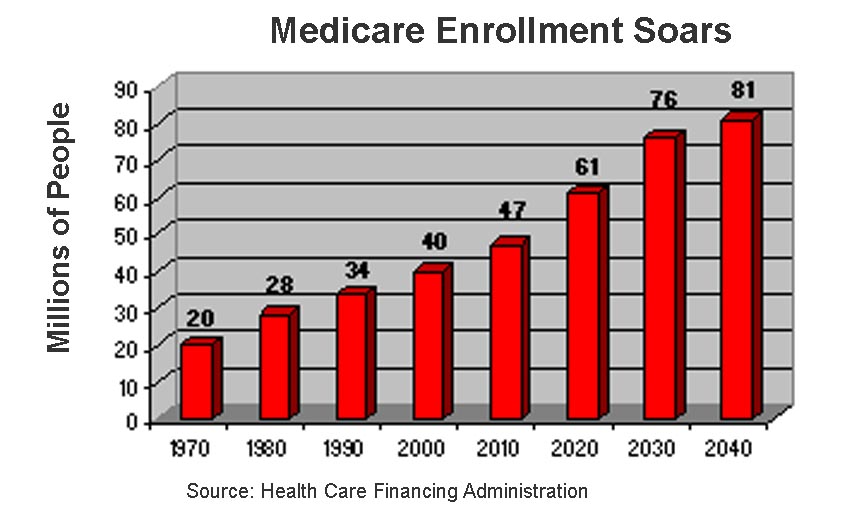
Then, it seems, all the concerns about Money and Inflation combined with anticipated Longevity for Boomer’s in general.  In simple terms, the Fear of Outliving Assets commands a high place on every Boomer’s list.  How to know when enough is enough, that’s the rub.  Assuming you think you have “enough” when its time to cut back and try to enjoy whatever is left of your days with our Federal Budget Deficit running in excess of $1 Trillion per year with no end in sight and accumulated debt at $16.5 Trillion and growing is frightening to say the least.  It seems we are being led to believe that allowing the Federal Government to keep minting money at breakneck speed is a good thing for our economy.  The believe that somehow we will spend our way out of our national fiscal problems flies in the face of all lessons economic I learned over the last 60 years.  The simple concept that was taught that when there is more and more currency in the system chasing a finite amount of goods and services the effect squirts out as inflation seems to have been lost in the current environment.  Thinking about a day when you might take that last distribution from an IRA account because your money ain’t worth what it used to be and it cost a lot more to live to that point than you ever thought possible and you are left with nothing but a meager monthly distribution from Social Security to support yourself and your spouse that is younger and much healthier than you – now that’s the stuff of which nightmares are made.

Another worrisome issue that jumped out at me, one I had not considered on my own because I have a committed and caring spouse, are the unique challenges facing Single Baby Boomers as they age.  I was somewhat taken aback to read that 1 in 3 of the almost 80 Million Boomers is either divorced or never-married or widowed and of that population of more than 25 Million Americans only 10% fall into the widowed category.  Among the commonalities of this growing segment is that they tend to be younger, female and non-white.  As a group, they become disabled at almost twice the rate of married couples and are less likely to have adequate health insurance.  The obvious concerns of who will care for them if they do become incapable on their own are exacerbated by the economic challenges of living alone.

Many Boomer’s are part of what is known as the “Sandwich Generation“; simultaneously having to care for family members that are both older and younger.  I think we all know Boomers that have been ensnared in that web with a living parent that needs a significant amount of care and children that have either never left the nest or have returned as victims of the challenging economy or other social problems.  The tax of the energy and resources on our contemporaries that are caught as the meat in the middle of this sandwich can be overwhelming.

Functional Decline is another concern of Boomers that I personally hadn’t spent much time thinking about, although I find it distressing that what I once thought of as my razor-sharp memory needs ever more reliance upon a digital calendar for prompts about the normal and necessary parts of day-to-day living.

Abuse, Neglect and Financial Exploitation have their own places up and down the roster of those things about which to be concerned.  I have a friend that is an attorney specializing in Elder Law.  Apparently, the need for this specialty is growing exponentially.

Death and Dying mixed up with cultural and religious beliefs creates its own menu of concerns for Boomers who want to have a say in how their own lives end.   How and when to make their wishes known to family members and the worries about whether those wishes will be honored are among the details that must be reconciled.

Where To Live is another challenge facing Boomers.  Layering the desires to be close to (or not) other family members, health care facilities, recreational opportunities, entertainment, shopping and religious facilities with the need or willingness to move from an existing home creates another set of insecurities.

My goal over the coming period of time is to explore these issues in-depth and other concerns that are brought to my attention with a focus on how best to attack each of the challenges as we age together.  If there is something keeping you awake at night that you would like to have me address please let me know.
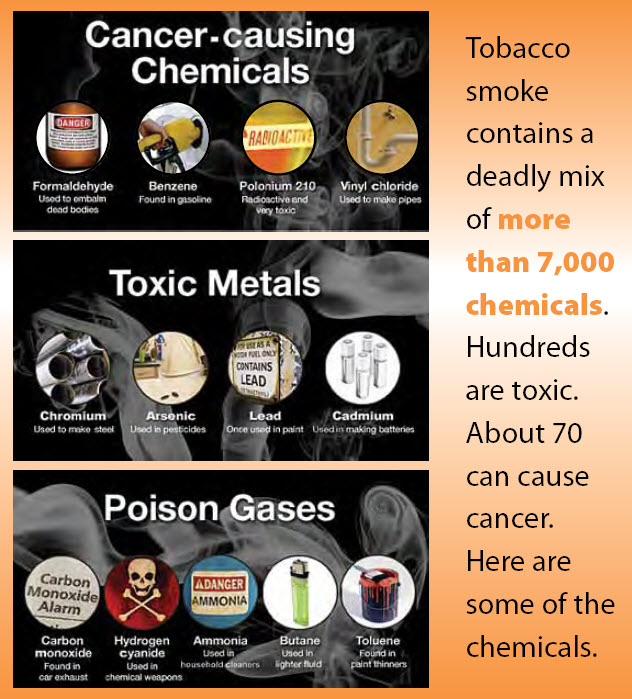

One in five American adults smokes some type of tobacco product.  Astonishing!  In the face of irrefutable evidence that smoking significantly shortens life span and denigrates the quality of that reduced time the beat apparently goes on.  In addition to the guarantee of an earlier death, the economic consequences to the individual and society as a whole are staggering.  The Center for Disease Control (CDC) reports that 443,000 deaths occur in the USA each year related to smoking; Still; Really.  Lung disease, cancer and heart ailments are at the top of the list of those smoking related ailments that contribute to the earlier than necessary demise of smokers.

chemicals_smokeThe New England Journal of Medicine recently published a study wherein researchers discovered that quitting smoking at every age up to 64 can add from 4 to 10 years to the life expectancy of the new non-smoker.   The sooner the activity is stopped, the better the life expectancy.  The study concluded that both men and women that died in 2006 and were smokers at the time of their demise were about 3 times more likely to have died during the term of the study than non-smokers.  This disparity is partly attributable to increased health standards for the non-smoking population.  Consider also that among Americans that died of lung cancer in the early 1960’s women who smoked were 2.7 times more likely to have died from that horrible disease than non-smoking women, while men in the 1960’s died at a rate that was 12 times more likely.  Pretty staggering info that pales in comparison when you come to understand that by 2010 that both men and women that died of lung cancer were smokers was 25 times the rate of non-smokers.  Women, I suspect, caught up to men in this regard due to the increased social acceptability of smoking by females and the larger influx of women into the workforce.  The increase in the overall death rates is in no small part attributable to advances in health care that has helped to stem the tide of other life ending conditions but apparently not so much lung cancer.

We have a number of video tapes of our family when we were kids in the 50’s and 60’s, usually of family gatherings around Christmas time.  In almost every tape the adults are seen with cigarettes burning in one hand and a drink in the other while the kids are scrambling at their feet to rip open their presents – quite often with one or more of the female adults obviously pregnant.  Our parents weren’t being careless or irresponsible, the simple fact is they did not KNOW what we know today about the harm that smoking causes.  I remember my Dad quit in the 70’s; cold turkey.  It was tougher for my Mom but she finally gave up the cigarettes in the 80’s as best as I can remember.

I smoked off and on from 1971 until 1984 – I suppose because everyone else did.  Mostly I worked office jobs and even if you didn’t have your own you spent your days inhaling everyone else’s tobacco smoke because that was just the way that it was.  When I quit for good it was as much for practical reasons than concerns about my health; I had just burned a hole in a brand new tie.  It wasn’t the first time it happened but I was committed it would be the last.

What we know today about cancer includes the understanding that you don’t “catch” cancer like a cold or the flu.  While there is a growing belief that viruses may be at the root cause of some cancers, many cancers require an “irritant” to which we are exposed over an extended period of time along with some genetic predisposition.  And, in many cases, it takes a good long time for the cancer that may be growing inside of us to become noticeable to health professionals.  Consider the mountain of evidence that exposure of our Soldiers, Sailors and Marines to Agent Orange and other defoliants in Vietnam and Korea are now manifesting themselves in deadly lymphomas, prostate cancer, respiratory (lung cancer) and skin cancers – in many cases 40 or more years after the exposure.  Lots of these service personnel also smoked creating what has proven to be an especially lethal cocktail.  Consider also that defoliants have been in use for agricultural and landscaping purposes all over American soil, albeit at much lower concentrations than in the forests of Asia where we so indiscriminately sprayed.  There is a growing body of evidence that chemicals of many kinds contain the keys to unlock predisposed molecule of DNA toward cancer in those of us that possess them.  Tobacco products release a number of chemicals into our organs when inhaled including cyanide, arsenic and lead – known carcinogens  Placing one of these burning time bombs between your lips is literally playing with fire.

I remember when Obamacare (The Affordable Health Care Act) was first being debated and we were told that it would take a number of years for all the features and benefits, along with the resulting costs, to be calculated and understood.  What folks heard (or wanted to hear) was that the program would guarantee affordable health care coverage for everyone but that the details still needed to be worked through.  Since most of the remaining major changes that will take place are scheduled to kick in beginning January 1, 2014 those heretofore unknown details are beginning to squirt out.  Consider the consequences for smokers.

There is a little talked about provision in the Act that allows insurers to charge smokers buying individual policies premiums that are as much as 50% higher than non-smokers.  Estimates range up to an additional $4,250 per year for coverage for a 55-year-old smoker as compared to his/her non-smoking contemporary.  Younger smokers will be charged lower penalties but I think its safe to project those surcharges will escalate along with age and a growing body of evidence that smoking in and of itself increases the potential healthcare expenses for individuals over their lifetimes.  While it is widely believed that surcharges will not be allowed for policyholders that may be overweight or have other pre-existing conditions that potentially require more medical care than average, the discrimination against smokers is allowable and likely.

Do yourself, your family, friends and bank accounts a favor.  If you smoke, quit now.  If you don’t smoke, don’t ever start. 


Under the auspices of the Consumer Financial Protection Bureau (CFPB), which sprung from the Dodd-Frank financial reforms, the US Treasury is readying its rules for what is referred to as a Qualified Residential Mortgage (QRM). While the rules are not yet final the advance information indicates there are at least a few things that are of particular interest to anyone hoping to purchase a home with a new loan or refinance an existing one. Boomers in particular will likely be impacted by a number of the proposed restrictions having to do with debt ratios, acceptable methods of documenting income and downpayment/equity. The changes have the potential to put the recovering housing market right back on its ear if they are all enacted as proposed as a large number of potential home buyers will no longer be able to qualify at the level they can today. While the new rules will not fully go into effect until January, 2014 you can bet that lenders will begin to layer the changes into their requirements as soon as they are convinced of the final regulations.

Because almost every loan (save for those made by “private” lenders) will need to conform to the new guidelines, the argument can be made that once again, the rules will serve to protect lenders from themselves while negatively impacting access to home mortgages. Consider that the proposal suggests that no loan can be considered where the overall debt ratio of the borrower exceeds 43% of their calculated gross monthly income – regardless of equity or liquid assets. While the argument can be made that 43% might be an appropriate number for most families, consider that conventional loans are currently approvable with debt ratios as high as 50% and we have seen recent FHA approvals as high as 57% if the loans are approved through a rules based, automated underwriting system. The impact in high-cost housing areas will be staggering when you consider that a 14% reduction in the maximum debt ratio effectively eliminates over 25% of the pool of eligible borrowers that heretofore would have qualified for the financing to purchase a particular home.

Consider, also, that many retired folks live off a combination of social security, income from retirement accounts and savings. To the extent that a borrower uses savings that are in non-retirement accounts to supplement social security, the withdrawal of those funds is not considered income and thus, cannot be considered in calculating the 43% maximum debt ratio under the CFPB rules as currently enacted. From the perspective of a borrower that is interested in mitigating tax liability and is able to draw upon non-taxable savings in deference to taxable withdrawals from IRA or 401K accounts the consequences can be staggering. We have already seen this manifest itself with borrowers that were fully able to purchase their retirement home and qualify for their loan of choice before the previous changes that came to the market in 2010 regarding the prescribed method for income documentation. Now, many of those existing homeowners can no longer qualify to refinance their current mortgages because the use of non-taxable savings for daily living expenses is no longer considered when calculating debt ratios and incomes (regardless of the balances in those accounts or the fact that they have been making the payments previously as agreed) – only funds withdrawn from taxable accounts can be counted. Layering into that reality those newly recommended debt ratios are set to be crunched down to a level that requires more and more income to qualify which can only mean higher and higher tax bills for the borrowers as they rearrange their finances to make themselves more credit-worthy in the eyes of the CFPB. The only alternative is to live with their current financing, which many times is at nearly twice the current interest rates or retire the debt with liquid assets, if available, which very well may trigger a whole new set of tax consequences.

I’ll do my best to try to keep you informed as the rules wind their way through the various governmental agencies. If you own a home and it’s not “free and clear” this is important stuff to understand.

TripBucket

We inspire our members to pursue their unique adventures and the accomplishment of their dreams.

St. Louis CEOs Against Cancer

Stories of local interest for the St. Louis CEOs Against Cancer

Seize every opportunity

Do you dream of travelling the world? Do you want to climb a mountain or go hang gliding over rio de janeiro? Make your dreams come true like I am

STORYTELLER

Photographer, Designer, Editor and Educator Ray Laskowitz talks about pictures and their back stories.

Blog By Boomer

One Boomer's Perspective on Living

WordPress.com News

The latest news on WordPress.com and the WordPress community.