Archive

Tag Archives: insurance


CBS’ 60 Minutes labasted the credit reporting industry on Sunday evening citing an FTC investigation that revealed that upwards of 20% of Americans had “errors” in their credit reports and that 10% had errors that were so serious as to have a dramatic effect on their credit scores.  Credit reports are engrained into the financial culture of our lives at a level where even the smallest errors could cause increases in the cost of many products ranging from life insurance to auto and home loans.  Because I am in the real estate lending industry I’ve seen thousands of credit reports as a necessary part of the loan process I am able to provide a testimonial that a lower credit score can have a dramatic impact on the cost of borrowing home mortgage money.  In fact, if you consider a hypothetical 30 year fixed rate loan for $300,000 and compare the interest rate that would be offered to a qualified borrower with a credit score in excess of 740 as compared to one provided to a borrower with a 639 credit score you will find that the borrower with the lower score would pay $137.66 more per month or an extra $50,000 over the 30 year life of the loan. Layering into that equation the reality that the low credit score borrower’s homeowner and auto insurance policies would command higher premiums its easy to understand why it’s vitally important to know, manage and protect that credit score.  For Boomers entering the phase of their financial lives where every dollar commands an increasing amount of respect, having control over the information in their credit reports takes on even greater importance.

There is a fundamental difference between a Credit Report and a Credit Score.  While consumers are allowed to obtain a free copy of their credit reports annually from all 3 of the primary repositories of credit information those complimentary reports do not include the “predictive” score that lenders and underwriters use in their pricing calculations.  When a consumer logs on to the website, www.annualcreditreport.com , the option is available to obtain at no cost the raw data that exists in the files that each of the credit bureaus maintains for every potential borrower.   However, if the consumer is motivated to find out just exactly what their “score” might be they are directed to the sites of the individual repositories where there are any number of options available for obtaining that score, all of which require the payment of an upfront fee and often times the hard sell to subscribe to a recommended service.  The only other option for knowing a credit score is to request that information from a lender or insurance company that may have recently obtained a credit report on a customer’s behalf.  The exact formula for determining an individual’s score is a closely guarded secret in the industry and one that is changeable based on the performance of the entire database but certain general rules separating good from bad credit scores are typically well-known such as making sure all payments are made on time, the level of outstanding balances on revolving credit accounts is low relative to the available credit amount and there is an absence of foreclosure or bankruptcy activity.

It is important to understand that the repositories of this data, TransUnion (TU), Experian (XPN) and EquiFax (EFX) are best thought of like one would a library. If a reader checks a book out of the library and they are unhappy with the content of that book they are bound to be disappointed if their expectation is that the librarian will have an impact on influencing the author of said book to change the content.   At best, the librarian could contact the author and lodge the complaint on behalf of the reader but changes in the content must come from the author directly in future editions.  In much the same way, consumers that discover erroneous information in their credit reports are best served by making their complaint directly to the provider of that wrong information and then obtaining written evidence that the report is, in fact, erroneous.  While the methodology exists for consumers to lodge their complaints with the credit bureaus reporting said errors, the credit reporting agencies responsibility begins and ends with their attempt to “investigate” said error on behalf of the consumer.  Most often, that involves an electronic message to the creditor indicating that the consumer doesn’t agree with the way the information is reported in their file, followed by the electronic response from the reporter as to their opinion about the validity of that information.  It is NOT the role of the credit bureau to ajudicate a dispute between a creditor and borrower.  On the other hand, if a consumer is armed with written evidence provided by the creditor that the report is in error, the credit bureau will most times immediately make the change to the consumer’s credit profile after validating the written proof.  While other types of errors occur, including those involving mistaken identity, far and away the disagreement about how an account is reported in an individual’s credit file causes most of the challenges for consumers.  There is a good amount of rhetoric floating around as a result of the FTC’s investigation into credit reporting practices that changes in those methods will occur.  However, it’s likely that years will transpire before meaningful modifications in the way those errors are investigated and reported will take place.  The intevening period could be quite expensive for those Boomers needing to borrow money or obtain insurance coverage.

As Boomers approach the promised land of their golden years its important that they know exactly what lenders, insurance underwriters and in many cases, prospective employers will see when they obtain a copy of their credit report.

Health Insurance – that’s a funny name when you think about it.  You virtually never use it when you are healthy; only when you are sick.  I’m thinking about it because I am home – sick with the flu.  I’m waiting for my primary care physician to call me back to let me know when I can visit her office.

We are owner’s of a small Real Estate Broker and Mortgage Company in Palm Springs.  Our Employee Benefits are handled by a provider that bills us for the monthly premiums for all of our insurances along with our payroll.  We are pretty vigilant about making sure we get the appropriate coverage at a good price; especially given my history of 2 major cancer bouts in the last 15 years.  Either of those would have bankrupted us without our insurance coverage.  It’s not a Cadillac plan; probably better referred to as a VW.  The coverage is within a HMO and I can honestly say I believe I have been provided every reasonable service to which I have been entitled since we have been part of this scheme.  Theoretically, we get reduced premiums because we get lumped together with a bunch of other small businesses and pre-existing conditions don’t affect the cost – only age.

Now here’s the rub.  My wife, she works with us in our business, just had what the provider refers to as a Milestone Birthday.   Apparently because she was one day older on January 27 than she was on January 26 the risk to the insurance company became so great that they needed to raise her premium by more than 30%!!  Since we don’t have an employer (other than ourselves) to pay their “portion” we get to see what it really costs – $766 each and every month for just her Illness Insurance – matching what we pay for mine.  The really scary part is I have a Milestone Birthday coming up in June and I have already been warned that my premium will jump from the aforementioned $766 to God knows what.  I suppose that since being 55 and 1 day old is 30% riskier than 54 and 364 days then turning 60 plus that one extra day probably means I will be at least 50% riskier to the insurance company than I am today.  Let’s hope not because our current premiums are more than our mortgage payment, taxes,homeowner’s dues and insurance on our home.  I could drive 3 or 4 different fancy cars for what I pay in illness insurance premiums.

In 5 short years I’ll be faced with the alphabetical decision-making that accompanies the conversion of my illness insurance to Medicare.  The more I read about Parts A through F the more confused I become.  I am not fearful that Medicare will disappear by the time I turn 65 – after all, my congressperson has promised me it won’t.  But, I am more than a little concerned that the my portion of the cost of the combination of the Affordable Health Care Act and whatever supplemental plans I will need to have will escalate to a level that provides no relief in this spiraling illness insurance cost structure.

I think thinking about this is making me sick.  When is that doctor’s office going to call me back?


One in five American adults smokes some type of tobacco product.  Astonishing!  In the face of irrefutable evidence that smoking significantly shortens life span and denigrates the quality of that reduced time the beat apparently goes on.  In addition to the guarantee of an earlier death, the economic consequences to the individual and society as a whole are staggering.  The Center for Disease Control (CDC) reports that 443,000 deaths occur in the USA each year related to smoking; Still; Really.  Lung disease, cancer and heart ailments are at the top of the list of those smoking related ailments that contribute to the earlier than necessary demise of smokers.

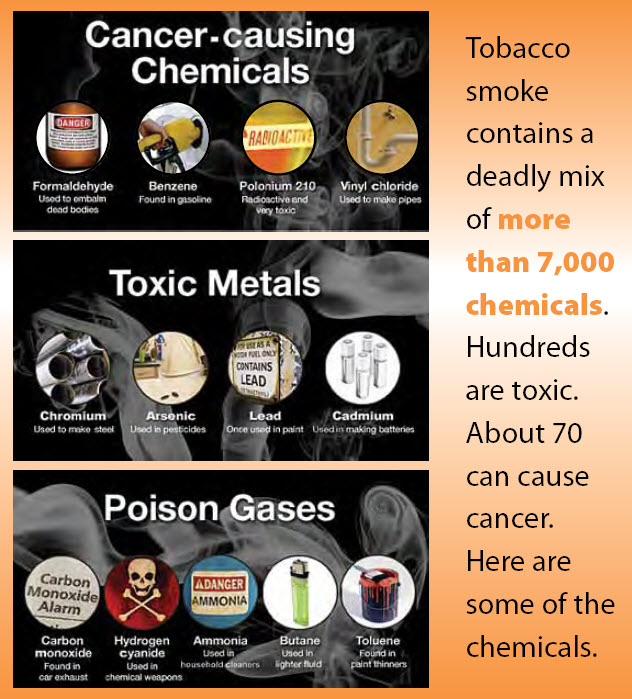
chemicals_smokeThe New England Journal of Medicine recently published a study wherein researchers discovered that quitting smoking at every age up to 64 can add from 4 to 10 years to the life expectancy of the new non-smoker.   The sooner the activity is stopped, the better the life expectancy.  The study concluded that both men and women that died in 2006 and were smokers at the time of their demise were about 3 times more likely to have died during the term of the study than non-smokers.  This disparity is partly attributable to increased health standards for the non-smoking population.  Consider also that among Americans that died of lung cancer in the early 1960’s women who smoked were 2.7 times more likely to have died from that horrible disease than non-smoking women, while men in the 1960’s died at a rate that was 12 times more likely.  Pretty staggering info that pales in comparison when you come to understand that by 2010 that both men and women that died of lung cancer were smokers was 25 times the rate of non-smokers.  Women, I suspect, caught up to men in this regard due to the increased social acceptability of smoking by females and the larger influx of women into the workforce.  The increase in the overall death rates is in no small part attributable to advances in health care that has helped to stem the tide of other life ending conditions but apparently not so much lung cancer.

We have a number of video tapes of our family when we were kids in the 50’s and 60’s, usually of family gatherings around Christmas time.  In almost every tape the adults are seen with cigarettes burning in one hand and a drink in the other while the kids are scrambling at their feet to rip open their presents – quite often with one or more of the female adults obviously pregnant.  Our parents weren’t being careless or irresponsible, the simple fact is they did not KNOW what we know today about the harm that smoking causes.  I remember my Dad quit in the 70’s; cold turkey.  It was tougher for my Mom but she finally gave up the cigarettes in the 80’s as best as I can remember.

I smoked off and on from 1971 until 1984 – I suppose because everyone else did.  Mostly I worked office jobs and even if you didn’t have your own you spent your days inhaling everyone else’s tobacco smoke because that was just the way that it was.  When I quit for good it was as much for practical reasons than concerns about my health; I had just burned a hole in a brand new tie.  It wasn’t the first time it happened but I was committed it would be the last.

What we know today about cancer includes the understanding that you don’t “catch” cancer like a cold or the flu.  While there is a growing belief that viruses may be at the root cause of some cancers, many cancers require an “irritant” to which we are exposed over an extended period of time along with some genetic predisposition.  And, in many cases, it takes a good long time for the cancer that may be growing inside of us to become noticeable to health professionals.  Consider the mountain of evidence that exposure of our Soldiers, Sailors and Marines to Agent Orange and other defoliants in Vietnam and Korea are now manifesting themselves in deadly lymphomas, prostate cancer, respiratory (lung cancer) and skin cancers – in many cases 40 or more years after the exposure.  Lots of these service personnel also smoked creating what has proven to be an especially lethal cocktail.  Consider also that defoliants have been in use for agricultural and landscaping purposes all over American soil, albeit at much lower concentrations than in the forests of Asia where we so indiscriminately sprayed.  There is a growing body of evidence that chemicals of many kinds contain the keys to unlock predisposed molecule of DNA toward cancer in those of us that possess them.  Tobacco products release a number of chemicals into our organs when inhaled including cyanide, arsenic and lead – known carcinogens  Placing one of these burning time bombs between your lips is literally playing with fire.

I remember when Obamacare (The Affordable Health Care Act) was first being debated and we were told that it would take a number of years for all the features and benefits, along with the resulting costs, to be calculated and understood.  What folks heard (or wanted to hear) was that the program would guarantee affordable health care coverage for everyone but that the details still needed to be worked through.  Since most of the remaining major changes that will take place are scheduled to kick in beginning January 1, 2014 those heretofore unknown details are beginning to squirt out.  Consider the consequences for smokers.

There is a little talked about provision in the Act that allows insurers to charge smokers buying individual policies premiums that are as much as 50% higher than non-smokers.  Estimates range up to an additional $4,250 per year for coverage for a 55-year-old smoker as compared to his/her non-smoking contemporary.  Younger smokers will be charged lower penalties but I think its safe to project those surcharges will escalate along with age and a growing body of evidence that smoking in and of itself increases the potential healthcare expenses for individuals over their lifetimes.  While it is widely believed that surcharges will not be allowed for policyholders that may be overweight or have other pre-existing conditions that potentially require more medical care than average, the discrimination against smokers is allowable and likely.

Do yourself, your family, friends and bank accounts a favor.  If you smoke, quit now.  If you don’t smoke, don’t ever start. 

TripBucket

We inspire our members to pursue their unique adventures and the accomplishment of their dreams.

St. Louis CEOs Against Cancer

Stories of local interest for the St. Louis CEOs Against Cancer

Seize every opportunity

Do you dream of travelling the world? Do you want to climb a mountain or go hang gliding over rio de janeiro? Make your dreams come true like I am

STORYTELLER

Photographer, Designer, Editor and Educator Ray Laskowitz talks about pictures and their back stories.

Blog By Boomer

One Boomer's Perspective on Living

WordPress.com News

The latest news on WordPress.com and the WordPress community.